I picked up the phone again. Live cold calls from a GTM engineer.
“You're probably gonna hate me, but this is a cold call.” “I'm driving in the car, mate. If the signal doesn't go, you've got 35 seconds.” That call ended with a date in January. Here's how it happened, and what the other calls taught me.

- I recorded myself cold calling UK B2B companies live, for episode 1 of a new series.
- The opener works. Saying straight away that it's a cold call, then asking for 35 seconds, kept most people on the line.
- The best call came from one observation: the person had started a new role three or four months earlier. It ended with a call-back booked for the second week of January.
- My pitch and my questions need work. I'll fix them episode by episode, in public.
Why a GTM engineer is cold calling
Most of my week goes on building outbound engines in  Claude Code: the lists, the research, the copy. A GTM (go-to-market) engineer is someone who builds the systems that find buyers and start conversations with them. Not someone who usually picks up the phone.
I hadn't been on the phones properly in a while. But we now offer cold calling alongside the engine, so I picked up the phone myself. I recorded a session of live calls to UK B2B companies that fit our ideal customer, and put it on YouTube, mistakes and all.
This is episode 1. By episode 10, the plan is that my pitch is a lot sharper than it is here.
The opener (copy it)
It works for two reasons. It says out loud what they're already thinking, that this is a cold call, so there's nothing to see through. And it hands them the choice: hang up, or give me 35 seconds. Most people gave me the 35 seconds.
The calls
I've left out names and companies. Here's what each call taught me.
“Pipeline's banging”
The first person I reached was driving over a hill, so the signal kept cutting out. Their pipeline was “banging”. All their sales come through partners. They'd once had a business development hire “that had all the tools in the world”, and it didn't work, because that's not how they sell.
Lesson: some businesses really do run on partners. Find out quickly, thank them, and move on.
“We built our own team”
The next person had already tried a bunch of agencies, decided to build an in-house team instead, and was “mid-flight”. Growth was gradual, but going in the right direction.
Lesson: someone halfway through building their own team won't switch tracks on a cold call. That's a conversation for later, if the team doesn't deliver.
“Not saying never, but not now”
This time I opened with an observation: I'd seen they were hiring cloud and data engineers. It turned out the UK business wasn't hiring. Other countries in their group were. The UK side was building its own sales team, and once a new sales leader was in place, that person would decide on anything like us.
“I'm not saying never, but I'm certainly saying not now.” They had “more work than we can eat”, and told me to come back in about six months. They also told me their marketing team already handles LinkedIn, so what they'd care about is help with the sales pipeline.
Lesson: check that your observation is about the part of the business you're actually calling. And a clear “not now”, with a date and a reason, is worth a lot more than a vague maybe.
“Call me in the second week of January”
This is the one from the top. Driving again, 35 seconds on the clock. I said what we do, that we've built our own outbound engine inside the Claude Code terminal, and then used the one fact I had: they'd started their role three or four months earlier. I asked how their pipeline was looking, and whether we could help build it before Q1.
Their honest answer: pipeline was pretty good, with partners as well as direct sales, and their small team was focused on closing Q4. Then:
“Jot down in Salesforce or Dynamics, whatever CRM you've got, to give me a call second week of January.”
Before then they'd talk to their CEO. Whatever happened, it would start as a pilot, and we'd have to prove ourselves, either with a list of the right prospects or with real meetings. I asked to connect on LinkedIn and to send an email with more detail. Yes to both.
“We're like a law firm”
I'd seen partners listed on their website, so I asked whether most of their work came through referrals. Yes, and it's always unpredictable, because the work is so specialist. They compared themselves to a law firm, which can't predict how many cases it'll get each month and makes up for it with high hourly rates. They'd been in the field for decades, it was steady, and they didn't need more.
I took that at face value and moved on. More on that below.
“No, I'm all right”
The last person I reached heard the opener and said, “No, I'm all right. Thanks very much. Cheers.” Fair enough. On to the next one.
What worked: one true observation
While I call, my second screen shows what our engine found about each person and company. It's the same observation waterfall we use for email: it ranks everything it knows and puts the most relevant true thing at the top.
For the January call, the top line was simple: a business development director, three or four months into the role. Someone new in a job like that wants to build pipeline, and fast. There's no such thing as too much pipeline. Mentioning it showed I'd done my homework, and it gave them a reason to keep talking to a stranger while driving.
The opener worked too. Saying it's a cold call and asking for 35 seconds got me a hearing on almost every call where I reached the right person.
What I need to fix: the pitch and the questions
On the law firm call, I accepted “it's always unpredictable” and moved on. I should have dug in. How unpredictable? What does a quiet month cost them? What happens when a big referral doesn't come through? That's where the real conversation was, and I left it on the table.
My pitch after the opener needs to be shorter and sharper too, and my fact-finding needs to go deeper. We've been focused on the engineering side of go-to-market for a while, and it showed.
A cold call only has to earn the next step
I think about selling a bit like dating. The cold call only has to get you a first date: the meeting. The meeting gets you to a proposal, and the proposal gets you to a yes. Each step just has to earn the next one.
So the job of a cold call isn't to close. It's to earn the meeting. And when the answer is “not now”, it's to leave with a next step: a LinkedIn connection, an email with more detail, a date to call back. One person gave me January. Another gave me six months.
Why our calling uses the same research as our emails
This is why we run cold calling alongside the engine rather than as a separate thing. The engine finds the right people and works out the most relevant thing to say to each one. The call picks up from there. It's the same list and the same research, with one goal: a meeting in the diary.
If you want to see how that research gets built, read how we build campaigns in Claude Code.
LIVE Cold Calls by a GTM Engineer (Brutal) | Ep. 1
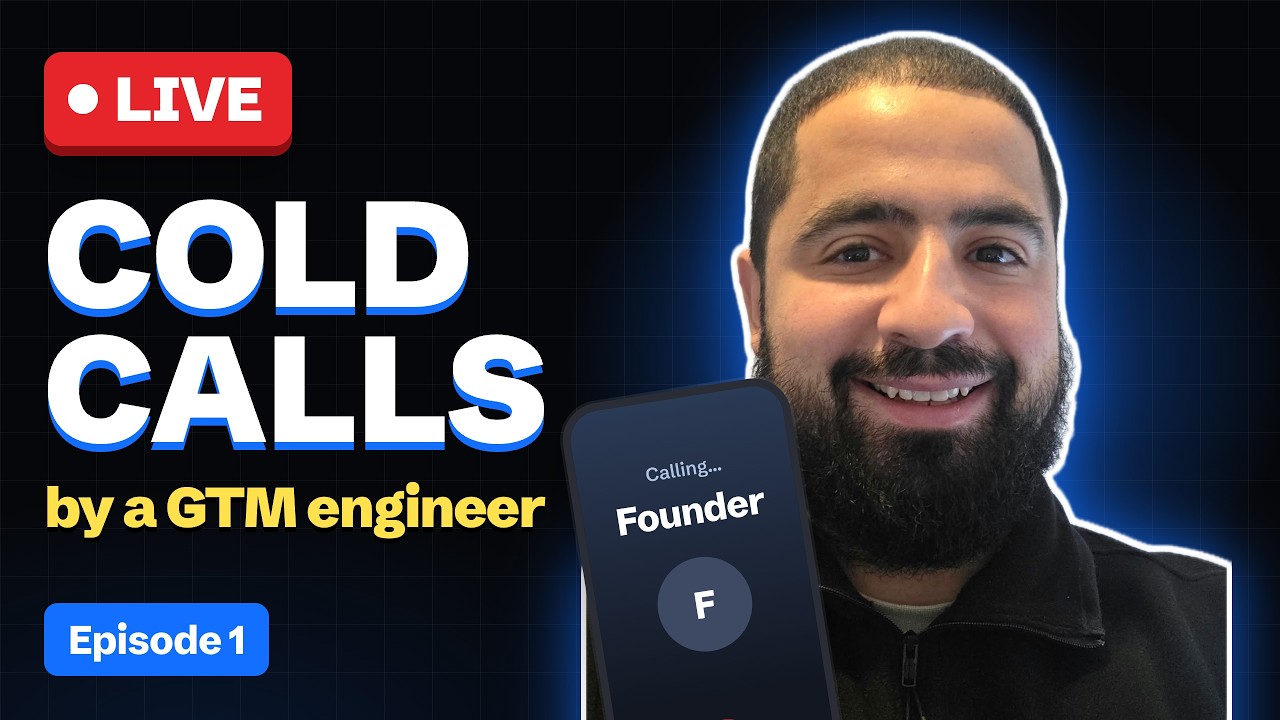 Watch on YouTube: youtu.be/3-A8bZ6Ic_8 →