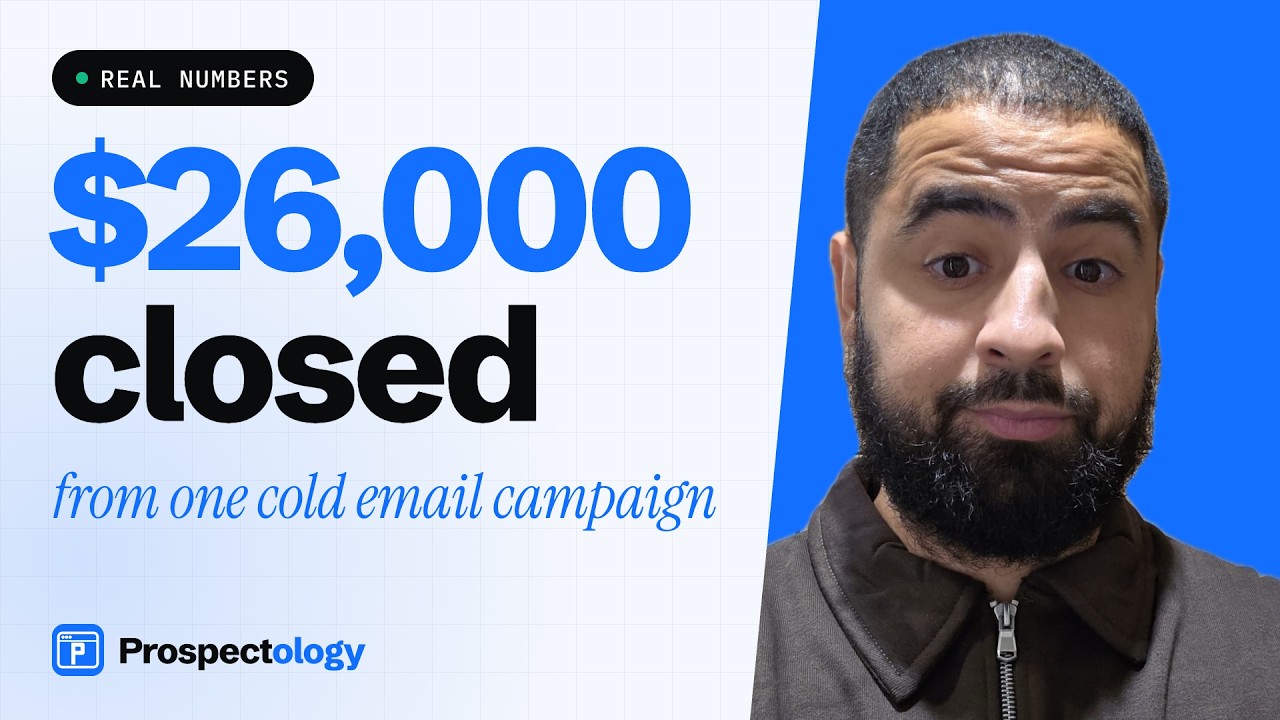
Cold email ROI isn't a reply rate. One campaign closed $26,000.
4,724 emails. A 2.2% reply rate. Seven positive replies. Not the kind of numbers that go viral on LinkedIn, and still one of the best campaigns we've run. Here's the story behind it, and the exact email that started the bigger deal.

- One cold email campaign, launched in September 2026, brought in $26,000 from two new clients: $14,000 and $12,000.
- It sent 4,724 emails to 1,200 people. The reply rate was 2.2%, with 7 positive replies and 3 meetings.
- The email behind the $14,000 deal was 63 words: one observation, why it matters, one named result and a soft offer.
- One of the two deals came from a reply to email 4, so don't stop after the first email.
- Judge a campaign on the business it brings in, not on its reply rate.
A hard summer
Summer 2026 was a tough stretch for us. A few clients left. Some ran out of budget, and with some, if I'm honest, we didn't get them the results they expected.
So we did what we tell every client to do. Before writing a single email, we looked at our own data.
Who was actually buying from us?
We went through our CRM and the recordings of our discovery calls. Then my co-founder Onia and I sat down with one question: what kind of company keeps booking calls with us?
Three kinds kept coming up, whether they found us through referrals, inbound, our LinkedIn content or our own outbound:
- cloud and platform engineering consultancies
- digital engineering agencies
- custom software and AI implementation firms
They had a lot in common. Most were founder-led, with the founder doing the selling and the client work. Growth came from referrals, their own network, inbound leads and events. Nobody owned outbound. Even where there was a sales leader, they rarely had time to keep up with the latest sales tools, email deliverability and which data sources to trust.
That gap is exactly what we fill. So we built a campaign for them.
Three people at every company
Most buying decisions involve more than one person, so we wrote to three at each company:
- The CEO, founder or managing director
- The sales leader: chief revenue officer, sales director or director of business development
- The marketing leader: CMO or head of marketing
We picked those three with our Multi-Persona Hypothesis, the method we use to work out who has a say in a purchase. Every person got a different message, written for their role, and we never wrote to more than three people at one company.
My bet was that the sales leaders would reply the most. I was wrong. The CEOs and founders replied the most.
The real numbers
That's it. No clever workflow and no 40% reply rate. Seven people said yes to something we offered: a case study, a useful guide, or a list built for them at no cost. Three of those seven became meetings, and two became clients, one worth $14,000 and one worth $12,000.
What reply rate should a cold email campaign get?
For cold email, 2.2% is a decent reply rate. But it's the wrong number to judge a campaign on.
You'll see posts about 100 replies and 30 meetings a month. Sometimes outbound looks like that. Most of the time it looks a lot more like this campaign. The number that matters is how much business a campaign brings in, or how much value it gives the people it reaches.
A campaign with a 2.2% reply rate that closes $26,000 beats a campaign with a 10% reply rate that closes nothing.
Don't stop after the first email
We usually send three emails in a sequence. This time I tested four.
Most replies came on email 1, which matches what we see for our clients too. That's where people tell you to leave them alone, ask for the thing you offered, or book a call.
Replies dropped with every email after that. But one of our two deals came from a reply to email 4. If we'd stopped at three, we'd never have heard from them.
The email that closed $14,000
Here it is, exactly as it was sent on 9 September:
Saw you're hiring a Data Engineer, with four roles open in total. Every firm I've seen hire at that pace hits the same problem: delivery headcount is committed before the pipeline is there to fill it.
We generated 85 SQLs in 4 months for OneID, including calls with OpenAI, Bending Spoons and Betfred.
Want to see the one-pager on how we did it?
Each line has one job:
- The observation. The company was hiring a data engineer, with four roles open. It's public and true, and it gives us a reason to write.
- Why it matters. It ties the hiring to the problem we solve. We'd heard it on discovery calls with firms like this again and again: they hire people to deliver the work before there's enough new work coming in to keep them busy.
- The proof. A named result with real numbers: 85 sales-qualified leads in four months for OneID.
- The soft call to action. An offer of something useful, not a request for 30 minutes of their time.
The founder read it and forwarded it to their director of business development, who booked a call with me. Two calls later, they became a client.
When we write like this for clients, some of them get nervous. They say it's too direct, not friendly enough. But a cold email doesn't need to be friendly. It needs to stand out in a busy inbox, be useful, and get to the point.
How to structure a cold email that gets replies
Every cold email we write follows the same five steps:
- Observation: something true and public about the company or the person.
- Context: why that matters, tied to what you sell. This is where most sales teams fall down. They mention a signal, then jump straight to their features.
- Cost of doing nothing, if it fits: what keeps happening if nothing changes.
- Social proof, if you have it: a named result. If you don't, you can still get replies.
- A soft call to action: offer something useful, like a case study, a one-pager or a short process you used for someone else. Nobody gives a stranger 30 minutes, but plenty of people will say yes to something useful.
Keep it under 80 words. Under 60 is even better. Most people read email on their phone first, so use short paragraphs with space between them.
What do you open with when there's nothing to say?
We use what we call an observation waterfall. Most companies give you several things you could mention. We rank them by how much each one matters to what we're selling, and lead with the best one:
- they're hiring
- they've raised money
- someone is new in their role, or has been in it a long time
- a partner or customer named on their website
Enterprise and mid-sized companies usually give you something. Smaller companies often don't. When we can't find anything true and relevant, we never make something up. We fall back to a pain point that comes with that person's role, or with their industry. So every message is either about them, or about the problem their job comes with.
The engine behind it
Nothing about this campaign was clever. It ran through the same engine we build for our clients, inside  Claude Code:
- A crib sheet: what's being sold, the proof, who buys it, which current clients to leave out, and notes from discovery calls.
- A list built from
 AI Ark and
 Prospeo, so we cover more people than any one source has.
- Every company checked against the ideal customer profile.
- The right two or three people picked at each company.
- Every email address verified before it's used, because bounced emails damage your sending domains.
- Research on every company with
 Exa,
 Parallel and
 PredictLeads.
- Copy written and checked against our rules: under 80 words, nothing made up, nothing that reads like AI wrote it.
- A person reads a sample of 250 to 500 messages and keeps tweaking until it's right. Nothing sends before that.
If you want to see how that engine works step by step, I built a whole campaign in it on camera: how we build cold email campaigns in Claude Code.
The lesson
I didn't have big expectations for this campaign. It brought in $26,000 in a month when we really needed it.
It wasn't the reply rate that made it work. It was writing to the right people, with a real reason to write, and following up with something new to say.
$26,000 Closed From This Cold Email Campaign
 Watch on YouTube: youtu.be/u77XbOTeTFk →